
Engineers are still landing interviews despite the layoffs because they stopped fighting for attention where everyone else is fighting, and started targeting where hiring is actually happening. The roles in AI, data, cloud, and security are still growing, and the people getting interviews reach hiring managers through referrals and direct outreach instead of the job-board black hole. The market did not close. It changed shape, and the engineers who adjusted are moving forward.
If you have been laid off or watched your applications vanish without a reply, you already know the hard part. The headlines have been relentless, and the fear is real. But underneath the noise, offers are still being extended every week. This is what those engineers are doing differently, and how you can do it too.
Yes. Hiring did not stop, it narrowed. The layoff numbers are real, but they tell only half the story, and the half most job seekers never see is the one that matters for your next move.
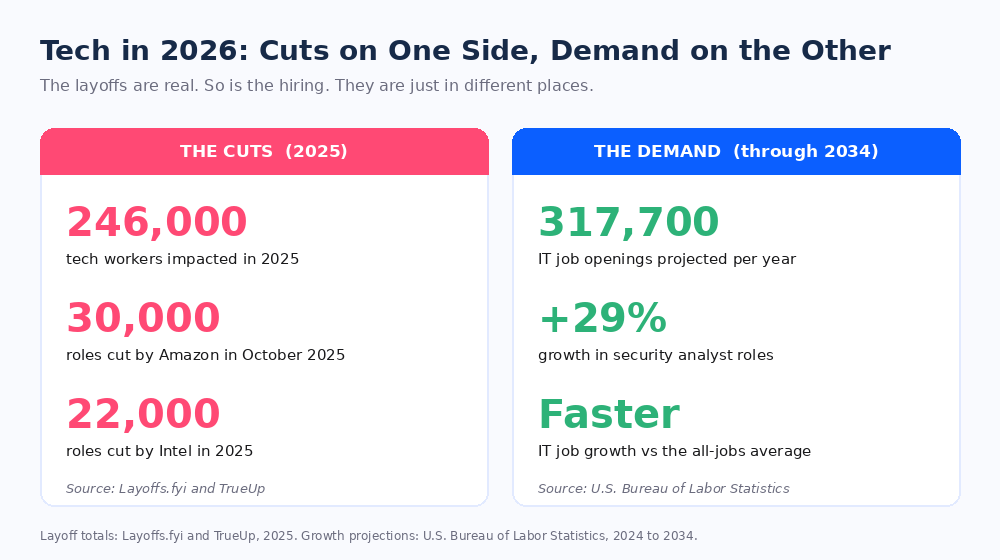
The cuts were brutal. Layoffs.fyi logged roughly 124,000 tech employees laid off across 269 companies in 2025, and a second tracker, TrueUp, counted close to 246,000 people impacted. Amazon cut about 30,000 roles in October 2025, and Intel announced 22,000 earlier in the year. Scrolling past that, it is easy to believe the door is shut.
Now the other half. The U.S. Bureau of Labor Statistics projects that computer and information technology occupations will grow much faster than the average for all jobs through 2034, with about 317,700 openings every year. Information security analyst roles alone are projected to grow 29 percent over that period. The market is shrinking and growing at the same time, just in different places.
That contradiction is the single most important thing to understand. Companies are cutting in some departments while hiring aggressively in others, and the engineers landing interviews are the ones who learned to tell the difference.
Because AI is reshaping which roles companies need, not erasing engineers across the board. The jobs disappearing are largely the ones automation can now absorb: manual QA, repetitive IT operations, junior content work, and entry-level generalist coding. The jobs growing are the ones that build, direct, and secure the systems AI runs on.
The data backs this up plainly. The World Economic Forum’s Future of Jobs Report 2025 names AI and big data the fastest-growing skills of the next five years, and estimates that 39 percent of a worker’s current skill set will be transformed or outdated between 2025 and 2030. LinkedIn has ranked AI engineer the fastest-growing job two years running, and reports that US roles requiring AI literacy jumped 70 percent year over year.
So a team that needed 15 generalist engineers might now ship the same work with 10 who use AI tooling well. That same company is often desperate to hire the specialists who design and maintain those AI-assisted systems. The pain and the opportunity sit side by side, which is exactly why raw skill is no longer enough on its own. We unpack that shift in why tech skills will not be enough in 2026, and it is worth your time.
Because volume is the wrong strategy in a market this concentrated. The approach most engineers still run, blasting identical resumes to hundreds of postings and hoping quantity wins, was built for a different era. Today it fails in ways it never used to.
With more applicants competing for fewer, more specialized roles, hiring managers are buried. Applicant tracking systems filter most resumes out before a human ever sees them, and lean teams cannot afford a wrong hire when every headcount counts. Sending more applications into that machine just feeds the filter that rejects you. That is why mass-applying to 500 jobs is the worst thing you can do in 2026, and why learning how the screening actually works, covered in our guide to bypassing the ATS, changes your odds more than another fifty applications ever could.
The engineers getting interviews are not sending the most applications. They are getting seen by the right people, in the right way, at the right moment. Even senior engineers feel this, and there are specific reasons why senior engineers struggle to get hired when they rely on the old playbook.
They run a focused playbook instead of a volume game. Four moves separate the engineers getting callbacks from the ones still refreshing their inbox. None of them require luck, and you can start every one of them this week.
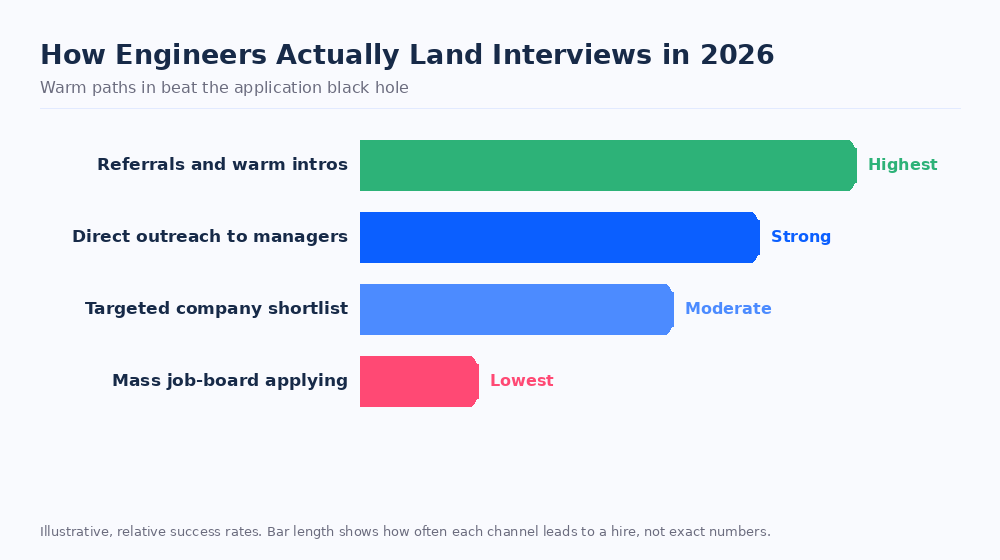
Notice the through-line. Every move trades volume for precision: fewer targets, sharper positioning, warmer paths in. That is the whole shift behind why some engineers keep getting interviews while others stall.
Nerdii was built for exactly this market. Instead of asking you to run harder at an approach that no longer works, it rebuilds the job search around what actually gets interviews in 2026. We find and apply to real roles on your behalf, while screening out the ghost jobs and scams that waste your time.
It starts with role matching based on real skill alignment, not keyword proximity, so every application has a genuine shot. From there, Nerdii helps you frame your experience in the language hiring managers and ATS systems are filtering for right now, which is repositioning your whole story, not just refreshing a resume. Where it separates itself is access: rather than cold applications disappearing into an inbox, Nerdii uses its network to put you in front of decision-makers through warm introductions. And when interviews come, you get preparation built around each company’s actual process, not generic practice. If that sounds like the help you need, you can Get Started with Nerdii today.
Yes. Hiring did not stop, it narrowed. Trackers logged well over 100,000 tech layoffs in 2025, yet the U.S. Bureau of Labor Statistics still projects computer and IT occupations to grow much faster than the average for all jobs through 2034, with about 317,700 openings a year. Companies are cutting generalist roles and hiring specialists, especially in AI, data, cloud, and security.
The roles tied to AI, data, cloud, and security hold up best. AI and machine learning engineering, data engineering, MLOps, cybersecurity, and platform reliability are all growing while broad generalist coding work shrinks. LinkedIn has ranked AI engineer the fastest-growing job two years running, so building real proof in one of those lanes is the safest bet.
Usually because you are applying the way that no longer works: high volume, generic resumes, cold submissions through job boards. Applicant tracking systems filter most resumes before a human reads them, and lean hiring teams cannot risk a wrong hire. Fewer, sharper applications that match the role and come with a warm intro convert far better than another hundred cold ones.
They use the hidden job market: referrals, warm introductions, and direct outreach to hiring managers before a role is even posted. Most hires happen through a connection, not a cold application. Building relationships inside a short list of target companies beats sending hundreds of applications into the void.
The market is not closed. It is asking you to show up differently: aim at the lanes that are still growing, lead with proof, reach people instead of portals, and send fewer, sharper applications. The engineers landing interviews right now are not luckier than you. They simply changed their approach before you did, and you can start any part of that today.
You do not have to do it alone. When you are ready to stop guessing and start landing interviews, start your Nerdii profile and put this plan to work.

Of tech companies surveyed, 40% posted fake jobs in the past year, and 79% of th...
The labor market is neither collapsing nor booming, creating what economists cal...
