
Here is the part that makes no sense until you see the math: sending more applications usually gets you fewer interviews, not more. Every generic application you fire off lowers your odds at each stage of the hiring funnel. The fix is not more volume, it is a targeted job search built on a sharper funnel. Let us walk the real numbers and show you where 100 applications actually go.
A typical scattered search looks like this. You apply fast and apply wide, then wait for replies that rarely come. Walk one illustrative funnel down stage by stage and the silence starts to make sense. Treat these figures as an example of how a high-volume search tends to collapse, not as a verified study.
That is the punchline. A hundred applications in, and almost no interviews out. The drop-off at every stage is the real story here, not bad luck.
The collapse is not random. Volume itself is what makes each stage of that funnel worse, and you can map every leak back to a stage you just saw.
Volume forces a generic resume, because you cannot tailor a hundred of them. A generic resume fails the keyword matching the ATS runs, so the top of the funnel narrows before a human ever looks. That is your ATS stage, gone.
Volume also pushes you toward roles that are not a real fit, because casting wide means casting carelessly. When a recruiter does open your application, the mismatch is obvious, and that guts your recruiter-view-to-callback rate. That is your callback stage, gone.
Volume leaves no time to tailor, research, or follow up. Without a sharp pitch and a follow-up, the few callbacks you do earn stall out, which kills the callback-to-interview rate. That is your interview stage, gone. Three stages, all bled dry by the same cause.
Now re-run the identical funnel, but focused. Far fewer applications go in, yet each one is tailored to the role and its keywords, aimed at a real-fit shortlist, and backed by a follow-up. Watch the pass rate climb at every stage. Lauren McGoodwin from Atlassian argues for exactly this in her targeted approach to the job search.
Three interviews from 15 applications beats 1 interview from 100. The smaller, sharper funnel wins because each application is worth more at every stage. This is strategy you own: pick the right roles, match the keywords, tailor the pitch, and follow up. The work is real, but it is the work that actually converts.
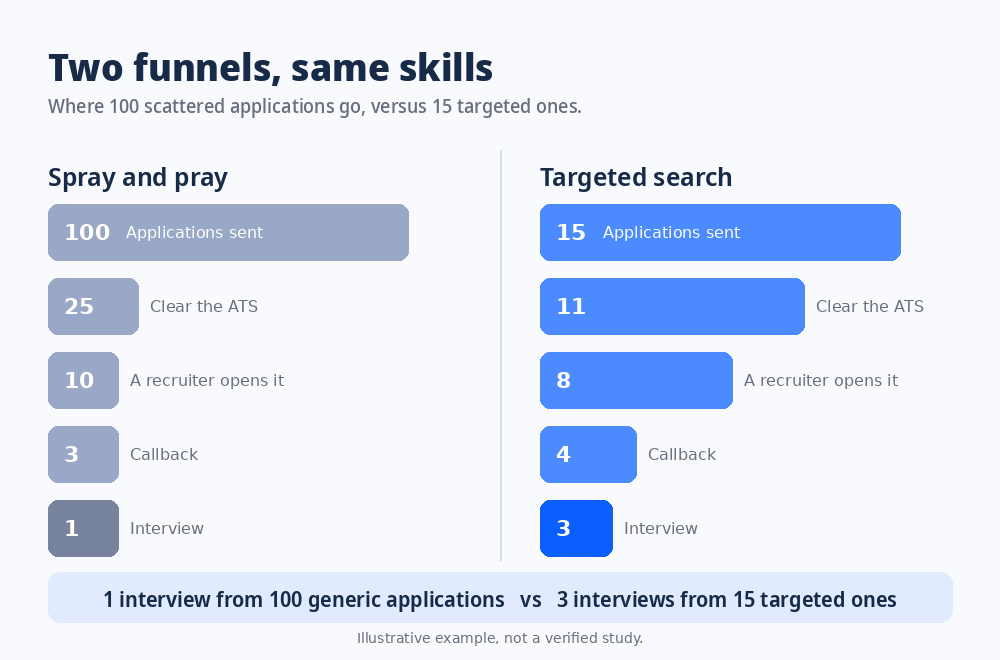
The chart above is an illustrative example, not a verified study, but the shape holds in practice: fewer, sharper applications produce more interviews than a flood of generic ones.
Running that targeted funnel takes time most job seekers do not have, especially after a layoff. Nerdii operates the funnel for you. We position your profile and apply on your behalf to right-fit roles, so the top of your funnel is sharp instead of scattered and the interviews land at the bottom.
The pricing is plain: your first 3 interviews are free, then $50 per interview, and a success fee of 10 days of your annual salary only if you actually get hired. Start your Nerdii profile and let the team run the targeted funnel for you while you focus on the interviews that count.
The market is saturated, and it punishes volume at every funnel stage while rewarding focus. Trade hundreds of dead-end applications for a handful that actually convert, and the math turns in your favor. Fewer, sharper applications produce more interviews than a thousand generic ones ever will.
You have seen the numbers. Start your Nerdii profile and run a funnel that ends in interviews instead of silence.

Of tech companies surveyed, 40% posted fake jobs in the past year, and 79% of th...
